
Quick answer: The best synonym for compensation depends on its meaning. For money given for work, use pay, salary, wages, remuneration, or earnings.
For money given for loss or harm, use reimbursement, restitution, indemnity, damages, or redress.
For something given in return for an effort or service, use reward, recompense, or return. In a business context, remuneration is formal, while pay is the most natural everyday choice.
What Does “Compensation” Mean?
The word compensation has several related meanings, which is why choosing the right synonym requires more than replacing one word with another.
In its broadest sense, compensation refers to something given to make up for something else. Depending on the context, it can mean:
-
Money or benefits received for work
The position offers competitive compensation. -
Money paid for a loss, injury, or damage
The customer received compensation for the delayed service. -
Something provided in exchange for effort or sacrifice
Her success was compensation for years of hard work. -
Something that balances or offsets a disadvantage
The additional support provided some compensation for the difficult circumstances.
This creates an important semantic distinction: compensation is not always simply “money.” It can describe payment for labour, financial redress for harm, a reward for effort, or an adjustment that offsets a disadvantage.
Compensation Synonym: The Quick Selection Guide
| If you mean… | Best synonym | Tone | Example |
|---|---|---|---|
| Money received for a job | Pay | Everyday | The job offers good pay. |
| Fixed regular employee payment | Salary | Neutral | Her salary increased this year. |
| Payment based on hours or work | Wages | Neutral | The workers receive weekly wages. |
| Formal payment for professional work | Remuneration | Formal | The remuneration package is competitive. |
| Money earned through work | Earnings | Neutral | His annual earnings have increased. |
| Money given as a reward | Reward | Positive | The bonus was a reward for excellent performance. |
| Payment for a service | Fee | Professional | The consultant charges a fixed fee. |
| Money returned for an expense | Reimbursement | Formal/Professional | You can claim reimbursement for travel costs. |
| Payment for loss or injury | Damages | Legal | The court awarded damages. |
| Restoration after wrongdoing | Restitution | Legal/Formal | The victim sought restitution. |
| Compensation for harm | Indemnity | Legal/Insurance | The policy provides indemnity against certain losses. |
| Correction for unfair treatment | Redress | Formal | The customer demanded redress. |
| Something given in return | Recompense | Formal/Literary | He received recompense for his efforts. |
| Benefit received in exchange | Return | Business | The investment generated a strong return. |
The Compensation Synonym Hierarchy
A useful way to understand this vocabulary is to place synonyms on a meaning ladder rather than treating them as interchangeable.
Level 1: General payment
Pay → Payment → Compensation
These words are broad and flexible.
- Pay is the most natural everyday term.
- Payment focuses on the act or amount of money transferred.
- Compensation often suggests payment connected to work, loss, or an adjustment.
Level 2: Employment-related compensation
Salary → Wages → Earnings → Remuneration
These words describe money associated with employment but differ in how they are used.
- Salary usually refers to fixed regular pay.
- Wages commonly refer to payment based on hours, days, or units of work.
- Earnings refers broadly to money earned.
- Remuneration is a formal umbrella term covering payment for work or services.
Level 3: Compensation for loss
Reimbursement → Indemnity → Damages → Restitution → Redress
These terms are more specialised.
- Reimbursement restores money someone spent.
- Indemnity protects against or compensates for specified loss.
- Damages are financial compensation awarded, especially through legal proceedings.
- Restitution aims to restore what was lost or wrongfully taken.
- Redress means a remedy for a wrong or grievance.
This hierarchy is one of the most important distinctions when selecting a compensation synonym.
Compensation Synonyms for Everyday Conversation
If you’re speaking casually, the best alternative is usually pay.
Pay
Definition: Money received in exchange for work.
Tone: Natural and conversational
Formality: Low to neutral
Best contexts: Everyday conversation, general writing
Common collocations:
- good pay
- fair pay
- low pay
- take-home pay
- equal pay
- weekly pay
Example:
The new job offers better pay.
Why choose it?
“Pay” sounds much more natural than “compensation” in ordinary conversation.
How much is the compensation?
How much is the pay? ✓
The second sentence is generally more conversational when discussing ordinary wages.
Compensation Synonyms for Employment and HR
Salary
Definition: A fixed amount of money regularly paid to an employee, typically expressed annually.
Tone: Neutral and professional
Formality: Neutral
Best contexts: Employment contracts, job discussions, HR
Example:
The company offered her a competitive salary.
Common collocations:
- annual salary
- starting salary
- base salary
- gross salary
- expected salary
Salary vs Compensation
Salary is narrower than compensation.
A salary is usually one component of an employee’s overall compensation.
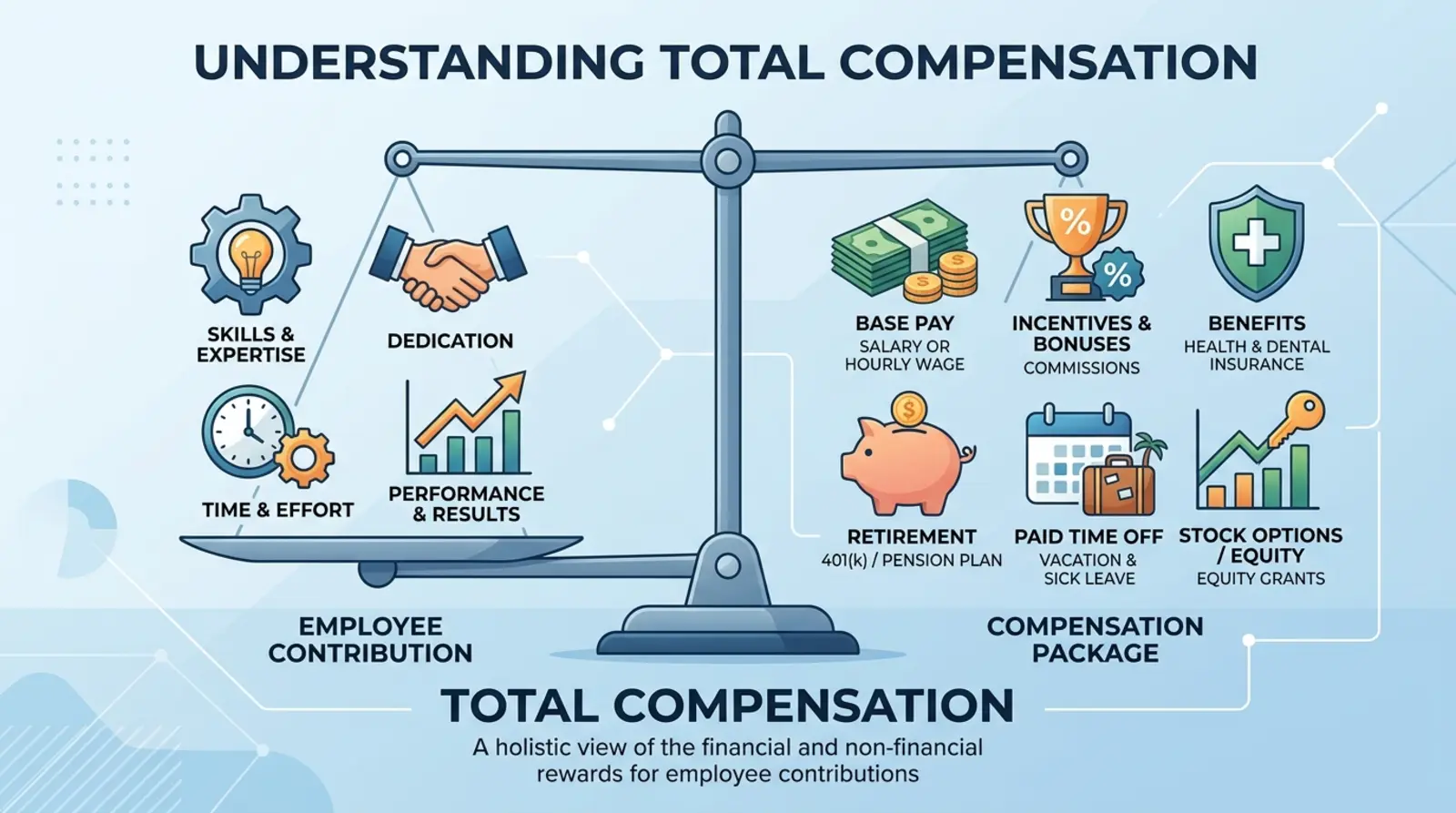
Compensation may include:
- salary
- bonuses
- commissions
- health benefits
- pension contributions
- paid leave
- stock options
- other employee benefits
Therefore:
Salary = one form of compensation
But:
Compensation ≠ salary only
Wages
Definition: Money paid for work, often calculated according to hours, days, or units produced.
Tone: Neutral
Formality: Neutral
Best contexts: Hourly employment, labour, payroll discussions
Example:
The workers are demanding higher wages.
Common collocations:
- minimum wage
- hourly wages
- higher wages
- fair wages
- wage increase
Salary vs Wages
The distinction is useful but not absolute.
| Salary | Wages |
|---|---|
| Usually fixed | Often variable |
| Commonly annualised | Often hourly or weekly |
| Typical for salaried employees | Common for hourly workers |
| More predictable | May depend on hours worked |
Remuneration
Definition: Money or other benefits received in exchange for work or services.
Tone: Professional and formal
Formality: High
Best contexts: HR documents, corporate reports, contracts, professional writing
Example:
The remuneration package includes a competitive salary and additional benefits.
Common collocations:
- employee remuneration
- executive remuneration
- remuneration package
- total remuneration
- competitive remuneration
Expert usage tip
Use remuneration when you want to sound precise and professional. However, it can feel overly formal in casual conversation.
Natural:
The company offers excellent pay.
Formal:
The company offers an attractive remuneration package.
Compensation Synonyms for Business Communication
Business writing often requires a distinction between payment, reward, and return.
Reward
Definition: Something given in recognition of achievement, effort, or good performance.
Tone: Positive and appreciative
Formality: Neutral
Best contexts: Employee recognition, achievements, incentives
Example:
The bonus was a reward for exceeding the annual sales target.
Compensation vs Reward
Compensation is generally something a person is entitled to receive in exchange for work or because of a loss.
Reward often implies something extra given because someone performed particularly well.
Salary = expected compensation
Performance bonus = potential reward
Fee
Definition: A payment charged for a professional service.
Best contexts:
- legal services
- consulting
- education
- medical services
- professional services
Example:
The solicitor’s fee was clearly stated in the agreement.
A fee is not a universal synonym for compensation. It specifically refers to a charge or payment associated with a service.
Earnings
Definition: Money earned through work, business, or investment.
Tone: Neutral
Formality: Neutral
Best contexts: Financial reporting, employment, personal finance
Example:
Her annual earnings increased after she changed careers.
Earnings focuses on what someone earns, whereas compensation focuses more broadly on what someone receives in return for work or service.
Compensation Synonyms for Legal and Financial Contexts
The legal meaning of compensation requires particularly careful word selection.
Damages
Definition: Money awarded to compensate someone for loss, injury, or harm, particularly in a legal case.
Example:
The court awarded damages to the injured party.
Best contexts:
- lawsuits
- personal injury
- property damage
- contractual disputes
Important distinction:
Not all compensation is damages, but damages can be a form of compensation.
Restitution
Definition: The act of restoring something that was lost, taken, or wrongfully obtained.
Tone: Formal and legal
Best contexts: Criminal law, legal remedies, restoration
Example:
The court ordered the defendant to pay restitution to the victim.
Restitution vs Compensation
- Restitution focuses on restoring the victim or returning what was lost.
- Compensation focuses more broadly on making up for loss or harm.
Reimbursement
Definition: Money paid back to someone for expenses they have already incurred.
Example:
Employees can request reimbursement for approved travel expenses.
Common collocations:
- expense reimbursement
- travel reimbursement
- reimbursement claim
- reimbursement policy
- medical reimbursement
Reimbursement vs Compensation
This is a common source of confusion.
Reimbursement = paying someone back for money they spent.
Compensation = payment given for work, loss, injury, or another qualifying reason.
If you buy a £100 train ticket for an approved business trip and your employer pays you back, that’s reimbursement.
If your employer gives you £100 as payment for your work, that’s compensation.
Indemnity
Definition: Protection or financial compensation against a particular loss or liability.
Tone: Highly formal
Formality: Legal/financial
Best contexts: Insurance, contracts, corporate law
Example:
The insurance policy provides indemnity against certain types of damage.
Common collocations:
- indemnity insurance
- indemnity clause
- professional indemnity
- indemnity agreement
This is a specialised term and should not replace “compensation” in ordinary writing.
Redress
Definition: A remedy or correction for a wrong, injustice, or grievance.
Example:
The customer sought redress after the company failed to resolve the complaint.
Redress can involve financial compensation, but it is broader than money.
Compensation may provide redress, but redress does not necessarily mean compensation.
Compensation Synonyms for Academic and Formal Writing
For academic writing, the best word depends heavily on the argument.
Useful options include:
- remuneration
- recompense
- restitution
- indemnification
- redress
- payment
- financial award
- monetary compensation
Recompense
Definition: Compensation or reward for loss, effort, or service.
Tone: Formal or literary
Example:
The workers sought recompense for the additional hours they had contributed.
“Recompense” is grammatically correct but less common in everyday modern English than compensation or payment.
Indemnification
Definition: The act of compensating someone for a loss or protecting them against financial liability.
Best contexts: Legal, insurance, corporate documents
Example:
The agreement contains provisions for indemnification against certain claims.
This is a highly technical term and should be avoided when a simpler word communicates the idea accurately.
Compensation Synonyms in Emotional and Creative Writing
When compensation is metaphorical rather than financial, words such as consolation, reward, recompense, and return may be more effective.
Consolation
Used when something provides comfort after disappointment or loss.
Her eventual success was little consolation after years of struggle.
Reward
Works well when the emphasis is on positive results.
The joy of helping others was its own reward.
Recompense
Works in elevated or literary writing.
His recognition was recompense for years of dedication.
Return
Useful when describing what comes back from an action or investment.
The friendship was a meaningful return for her kindness.
Compensation vs Related Words: The Key Differences
| Word | Core meaning | Best use |
|---|---|---|
| Compensation | Something given to make up for work, loss, or harm | General |
| Pay | Money received for work | Everyday employment |
| Salary | Fixed regular employment income | Salaried jobs |
| Wages | Payment often based on hours or work | Hourly/labour work |
| Remuneration | Formal payment for work or service | HR/business |
| Reward | Something given for achievement | Performance |
| Reimbursement | Money paid back for expenses | Business expenses |
| Damages | Legal financial award for harm/loss | Law |
| Restitution | Restoration after wrongdoing | Legal |
| Indemnity | Protection against specified loss/liability | Insurance/contracts |
| Redress | Remedy for a wrong | Complaints/injustice |
| Recompense | Compensation or reward | Formal/literary |
How to Choose the Right Compensation Synonym
Use this simple context decision tree:
Are you talking about money received for a job?
→ Use pay, salary, wages, earnings, or remuneration.
Are you talking about money paid back for an expense?
→ Use reimbursement.
Are you talking about money awarded because of injury or legal harm?
→ Use damages.
Are you talking about restoring something lost or taken?
→ Use restitution.
Are you talking about protection against financial loss?
→ Use indemnity or indemnification.
Are you talking about correcting a wrong or grievance?
→ Use redress.
Are you talking about recognition for achievement?
→ Use reward.
Are you writing formal corporate or HR content?
→ Consider remuneration.
Are you speaking casually?
→ Pay is usually the most natural choice.
Compensation Synonyms by Formality Spectrum
Think of vocabulary as a spectrum:
Casual
Pay → Money → Earnings
Neutral
Payment → Salary → Wages → Compensation
Professional
Remuneration → Reimbursement
Legal/Technical
Damages → Restitution → Indemnity → Indemnification
Formal/Literary
Recompense → Redress
The key lesson is that the “best” synonym is not necessarily the most sophisticated word. The best synonym is the word that matches the intended meaning and audience most precisely.
Common Collocations with Compensation
Learning words in phrases is often more useful than memorising isolated synonyms.
Common collocations include:
- financial compensation
- monetary compensation
- fair compensation
- adequate compensation
- reasonable compensation
- additional compensation
- employee compensation
- total compensation
- compensation package
- compensation scheme
- compensation claim
- compensation payment
- compensation for loss
- compensation for injury
- compensation for damages
- compensation for services
Natural examples
Employees receive a comprehensive compensation package.
The victim sought financial compensation for the injury.
The company offered reasonable compensation for the damaged property.
The role includes competitive compensation and additional benefits.
Common Mistakes When Using Compensation Synonyms
1. Using “salary” when you mean total compensation
A salary is usually only one part of a compensation package.
Better:
The total compensation package includes salary, bonuses, and benefits.
2. Using “reimbursement” for payment for work
Reimbursement means paying back expenses.
Incorrect:
My reimbursement for the job is £3,000.
Better:
My compensation for the job is £3,000.
3. Using “damages” in ordinary employment contexts
“Damages” carries a strong legal meaning.
Better:
Use compensation or pay for general employment contexts.
4. Assuming every synonym is interchangeable
Words can share a broad semantic field while having different grammatical, legal, or contextual meanings.
For example:
Compensation ≠ reimbursement
Compensation ≠ salary
Compensation ≠ damages
Compensation ≠ reward
They overlap, but they are not identical.
5. Choosing complexity over clarity
In most everyday writing, pay is better than remuneration.
In a legal document, however, indemnification may be more precise than the general word compensation.
Precision should always come before sophistication.
Antonyms of Compensation
The exact antonym depends on the meaning.
Possible opposites include:
- loss
- penalty
- deduction
- deprivation
- disadvantage
- withholding
- forfeiture
- cost
- expense
For example:
Compensation offsets a loss.
A penalty adds a financial burden.
The relationship is contextual rather than a simple one-word opposite.
Vocabulary Development: How to Learn Compensation Synonyms
Instead of memorising a list of 30 words, learn vocabulary through semantic families.
Family 1: Work and employment
Pay → Salary → Wages → Earnings → Remuneration
Family 2: Loss and harm
Compensation → Damages → Restitution → Redress
Family 3: Expenses
Payment → Reimbursement → Repayment
Family 4: Recognition
Reward → Recompense → Return
Family 5: Risk and liability
Indemnity → Indemnification
This approach helps you understand why a word is appropriate instead of simply remembering that it is “a synonym”.
Pronunciation Notes
The pronunciation of compensation is approximately:
kom-pen-SAY-shun
The stress falls on the third syllable: SAY.
Some related words can be more difficult:
- remuneration — stress commonly falls on -AY-
- recompense — pronunciation varies according to meaning and grammatical use
- indemnity — stress commonly falls on -DEN-
- reimbursement — stress commonly falls on -BURSE-
When learning advanced vocabulary, pronunciation should be learned alongside meaning and usage.
Expert Writing Advice: Replace “Compensation” Only When Necessary
One of the biggest mistakes in synonym-based writing is assuming that replacing a repeated word automatically improves the text.
It doesn’t.
If you’re writing:
The employee received compensation. The compensation was fair, and the compensation reflected his experience.
You could revise it as:
The employee received a competitive salary that reflected his experience.
The second version is stronger because it improves precision, not because it uses more synonyms.
Professional editing rule
Before replacing “compensation”, ask:
- What exactly does the word mean here?
- Is money involved?
- Is the payment for work or for loss?
- Is the context legal, financial, professional, or conversational?
- Does the audience understand specialised terminology?
- Would a simpler word be clearer?
This meaning-first editing method is usually more effective than using a thesaurus mechanically.
Frequently Asked Questions About Compensation Synonyms
What is the best synonym for compensation?
There is no single best synonym. Pay is best for everyday employment contexts, salary for fixed employment income, remuneration for formal professional contexts, reimbursement for repayment of expenses, and damages for legal compensation for harm.
What is a simple word for compensation?
The simplest everyday alternative is usually pay when discussing employment. Payment can also work when referring more generally to money given or transferred.
Is “salary” a synonym for compensation?
Sometimes, but not always. Salary is a specific form of compensation paid regularly to an employee. Compensation can also include bonuses, commissions, benefits, and other forms of payment.
Is “remuneration” the same as compensation?
They are closely related. Remuneration generally refers to payment or benefits received for work or services, while compensation has a broader range of meanings and can also refer to payment for loss or injury.
What is the synonym of compensation for loss?
Depending on the context, possible terms include damages, restitution, indemnity, redress, reimbursement, and recompense. The correct choice depends on whether the loss involves legal harm, expenses, wrongdoing, insurance, or another situation.
What is the difference between compensation and reimbursement?
Compensation is a broad term for something given in return for work or to make up for loss or harm. Reimbursement specifically means paying someone back for money they have already spent.
What is the difference between compensation and reward?
Compensation generally refers to payment or benefits owed or provided for work, services, or loss. A reward is typically something given in recognition of achievement, effort, or exceptional performance.
What is a formal synonym for compensation?
Depending on context, remuneration, recompense, indemnity, or restitution may be appropriate formal alternatives. However, each has a different meaning, so they should not be used interchangeably.
What is the opposite of compensation?
There is no single universal antonym. Depending on the context, possible opposites include loss, penalty, deduction, deprivation, disadvantage, or withholding.
Final Recommendation: The Best Compensation Synonym Depends on Context
The most important lesson is simple: synonyms are rarely perfect substitutes.
If you are talking about ordinary employment, choose pay.
If you mean fixed employment income, choose salary.
If you mean hourly or work-based income, choose wages.
If you are writing an HR or corporate document, consider remuneration.
If someone is getting money back for an expense, use reimbursement.
If a court awards money for harm, use damages.
If the goal is to restore what was wrongfully lost, use restitution.
If the issue involves contractual or insurance protection against loss, use indemnity.
If you are describing recognition for exceptional achievement, use reward.
And when none of these specialised meanings apply, compensation remains the safest broad term.
The real skill in vocabulary development is therefore not knowing the largest possible list of synonyms. It is knowing which word carries the exact meaning, emotional tone, level of formality, and contextual nuance you intend. That is what turns ordinary vocabulary into precise, effective communication.

Creating motivational and viral-ready captions for modern audiences.